

Lead generation for coaching websites is the process of converting anonymous visitors into identified prospects through targeted messaging, structured user journeys, and value-driven capture mechanisms. Your website is your storefront and your handshake. If it isn’t actively pulling people into your world, it’s quietly losing them to someone else. Understanding how coach websites generate leads means looking beyond traffic numbers and focusing on what happens the moment a potential client lands on your page. The right combination of lead magnets, clear calls-to-action (CTAs), and a defined client journey turns casual browsers into booked calls.
What key website elements drive lead generation for coaches?
The coaches who consistently fill their pipelines share one thing in common: their websites do the heavy lifting before any conversation starts. Every page answers the visitor’s first question, “Is this person for me?” within seconds. That clarity is what separates a lead-generating site from a digital brochure.
Here are the core elements that make the difference:
-
A clear value proposition above the fold. Visitors decide within seconds whether to stay or leave. Your headline must state who you help, what you help them achieve, and why you’re the right person. “I help burned-out executives reclaim their time and lead with confidence” beats “Welcome to my coaching practice” every single time.
-
CTAs on every page, repeated on long pages. Consistent CTAs remove friction by making the next step obvious at every scroll point. Don’t make visitors hunt for a “Book a Call” button. Put it where they are.
-
Lead magnets that offer real standalone value. Lead magnets work as ebooks, video series, quizzes, or targeted email sequences. The key word is value. A freebie that feels like a throwaway hurts your credibility. If you wouldn’t charge for it, rethink it.
-
Testimonials and client journey stories. Social proof isn’t decoration. It answers the skeptical voice in every visitor’s head. Specific results (“I went from zero clients to a full roster in 90 days”) outperform vague praise (“She’s amazing!”) by a wide margin. You can learn more about building website trust with testimonials and client journey frameworks.
-
A defined client journey. A clearly defined client journey sets expectations, appeals to different buyer types, and reduces confusion. Show visitors exactly what working with you looks like, from first contact to transformation.
Pro Tip: Your lead magnet works best when it functions as a relationship starter that demonstrates your coaching style before asking for a call. Think of it as a free sample of your thinking, not just a freebie.
What are realistic benchmarks for lead conversion on coaching sites?

Knowing your numbers matters. Without benchmarks, you’re flying blind and optimizing for feelings instead of facts.
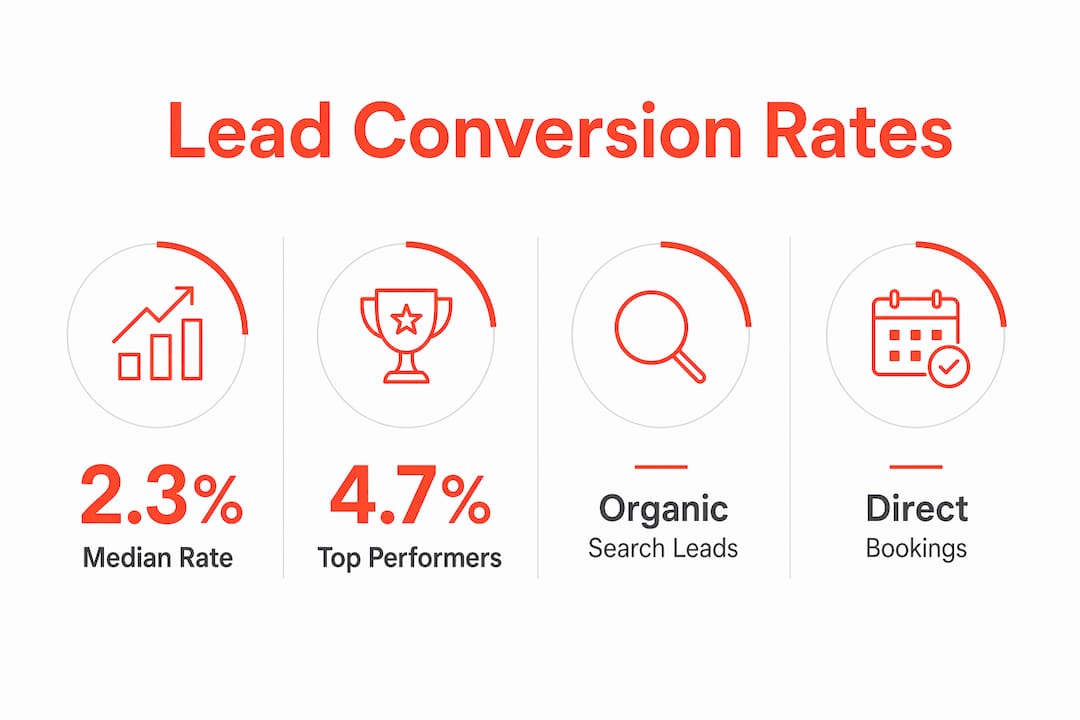
The median visitor-to-lead conversion rate for B2B websites in 2025 was 2.3%, with top-performing programs reaching 4.7% or higher. For coaches, this means that if 1,000 people visit your site monthly and you’re converting at 2.3%, you’re capturing roughly 23 leads. Top-quartile performers capture more than double that with the same traffic. The difference is almost never more ads. It’s a better conversion path.
Once someone becomes a lead, the next benchmark is getting them on a call. Qualified-to-booked lead conversion sits at a median of 62%, with top-quartile performers hitting 72%. That gap between median and top-quartile represents real revenue. Coaches who use instant scheduling tools instead of manual back-and-forth email close that gap consistently.
| Metric | Median | Top Quartile |
|---|---|---|
| Visitor-to-lead conversion rate | 2.3% | 4.7%+ |
| Lead-to-booked-call rate | 62% | 72% |
| Scheduling inefficiency (manual) | 35–40% loss | Reduced with instant scheduling |
“The true bottleneck in coaching lead generation is rarely traffic volume. It’s the conversion path. Fix the path first, then scale the traffic.” — RevenueHero, 2025
Organic search remains one of the most cost-effective lead sources for coaches. Visitors who find you through Google are already looking for what you offer, which means they convert at higher rates than cold social traffic. Investing in coach website copywriting that speaks directly to search intent pays dividends long after you publish it.
Why do coaches lose leads and clients online?
The struggle is real, and it’s more common than you’d think. Most coaches assume their lead problem is a traffic problem. It almost never is. Most coaches lose leads due to unclear positioning, a missing client journey, and no obvious next step after a visitor shows interest. More traffic poured into a leaky site just means more wasted opportunity.
Here are the most common reasons coaches lose clients online:
-
Unclear positioning. If your website tries to speak to everyone, it resonates with no one. A life coach who also does business coaching and wellness consulting looks unfocused. Visitors need to feel immediately understood, not confused.
-
No structured next step. A visitor reads your About page, feels inspired, and then… nothing. No CTA, no lead magnet, no invitation. They close the tab. You lost them forever.
-
Weak or absent social proof. Visitors who don’t know you need evidence that you’ve helped people like them. Without testimonials, case studies, or recognizable credentials, trust doesn’t form fast enough to capture a lead.
-
Manual scheduling friction. Legacy manual scheduling creates 35 to 40% inefficiency in the lead-to-booking process. Every extra email in a scheduling back-and-forth is a chance for the lead to cool off and disappear.
-
Inconsistent messaging across pages. Your homepage promises transformation, but your services page reads like a corporate resume. That disconnect breaks trust and kills conversions.
Pro Tip: Add a scheduling tool like Calendly or Acuity directly to your website’s “Book a Call” page. Removing the email back-and-forth alone can meaningfully increase your booked call rate.
The fix isn’t complicated, but it does require honest self-assessment. Walk through your own website as if you’re a skeptical stranger. If you can’t find a clear offer and a next step within 10 seconds, your visitors can’t either.
How can coaches optimize for AI search and boost lead visibility?
Search is changing fast. In 2026, Google AI Overviews appear at the top of results for millions of queries, and they pull answers directly from well-structured web pages. If your coaching website isn’t formatted for AI citation, you’re invisible to a growing share of your potential clients.
Here’s how to structure your site content for AI-driven visibility:
-
Write in short, direct answer blocks. AI systems prefer content blocks of 40 to 60 words that answer a specific question clearly. Long, winding paragraphs get skipped. Lead with the answer, then add context.
-
Add FAQ sections to key pages. FAQs are gold for AI citation. They match the question-and-answer format that AI Overviews extract directly. Add a FAQ section to your homepage, services page, and blog posts.
-
Use schema markup. FAQPage and Article schema markup improves AI extraction and citation probability. Your web developer or a plugin like Yoast SEO can implement this without a full site rebuild.
-
Define your entity clearly. Entity differentiation means Google’s AI understands exactly who you are, who you serve, and what makes you different. State this explicitly on your homepage and About page. Don’t make the algorithm guess.
-
Build topical authority with consistent content. Publishing regular blog posts or articles on your coaching niche signals to Google that you’re an authoritative source. Content structured for AI citation outperforms even higher-authority brands with poorly structured text because AI rewards clarity over domain metrics alone.
| Content approach | AI citation likelihood | Lead generation impact |
|---|---|---|
| Long, unstructured paragraphs | Low | Minimal organic visibility |
| Short answer blocks with FAQs | High | Increased qualified traffic |
| Schema markup + entity clarity | Highest | Strongest AI Overview presence |
The coaches who show up in AI Overviews for searches like “how to find a life coach” or “executive coaching for burnout” are capturing leads before a competitor’s website even loads. That’s a real competitive edge worth building toward.
Key takeaways
Coaching websites generate leads most effectively when they combine a clear value proposition, high-quality lead magnets, frictionless scheduling, and content structured for both human readers and AI-driven search.
| Point | Details |
|---|---|
| Conversion path over traffic | Fix your site’s clarity and CTAs before spending on ads or SEO campaigns. |
| Lead magnet quality matters | Offer something genuinely valuable; low-effort freebies reduce trust and opt-in rates. |
| Benchmark your conversion rates | Aim for 2.3%+ visitor-to-lead and 62%+ lead-to-call booking rates as your baseline. |
| Eliminate scheduling friction | Instant scheduling tools reduce the 35 to 40% drop-off caused by manual follow-up. |
| Structure content for AI search | Short answer blocks, FAQ schema, and entity clarity increase AI Overview citation probability. |
What I’ve learned from watching coaches win and lose online
I’ve seen coaches with beautiful websites get zero leads and coaches with simple, clear sites book out their calendars in weeks. The pattern is consistent. The ones who win aren’t necessarily the best coaches. They’re the ones whose websites make it easy to say yes.
The biggest trap I see is treating a lead magnet as a checkbox. Coaches slap together a PDF, bury the opt-in at the bottom of the page, and wonder why nobody signs up. A lead magnet is the first real impression of your coaching. It should make someone think, “If the free stuff is this good, the paid work must be incredible.”
I’m also a firm believer that your website needs a scheduled content review every quarter. AI search rewards freshness and topical consistency. A blog post you wrote two years ago with outdated advice can actually hurt your credibility with both visitors and algorithms. Keep your site current, and it keeps working for you. Pair that with a solid email marketing setup to nurture leads after they opt in, and you’ve built a system that runs whether you’re coaching or sleeping.
— Three
Get a coaching website that actually generates leads
If reading this made you realize your current site isn’t doing enough work for you, that’s a good thing. Clarity is the first step.
Threedaylaunch builds custom coaching websites in just three days, fully designed for lead generation and client conversion. No templates, no months-long timelines, no guesswork. Every site includes the features covered in this article: clear CTAs, lead magnet integration, scheduling tool setup, and copy structured to attract your ideal clients. Coaches in life, finance, health, and business have seen real results, including significant membership growth and organic sales, shortly after launch. If you’re ready to stop losing leads to a website that isn’t built to convert, Threedaylaunch is where to start.
FAQ
What is lead generation for a coaching website?
Lead generation for a coaching website is the process of capturing contact information from interested visitors through tools like lead magnets, opt-in forms, and CTAs, turning anonymous traffic into identifiable prospects you can follow up with.
What conversion rate should coaches expect from their website?
The median visitor-to-lead conversion rate for B2B and service-based websites in 2025 was 2.3%, with top performers reaching 4.7% or higher. Coaches who optimize their conversion path rather than just increasing traffic see the biggest gains.
Why are coaches losing leads even with decent website traffic?
Most coaches lose leads due to unclear positioning, missing CTAs, and no structured next step after a visitor shows interest. More traffic into a poorly structured site produces more lost opportunities, not more clients.
How do lead magnets help coaches get more clients?
Lead magnets convert visitors into leads by exchanging valuable content, such as a quiz, ebook, or email series, for contact information. They work best when they demonstrate your coaching style and deliver genuine value before asking for a call or purchase.
How does AI search affect lead generation for coaches in 2026?
Google AI Overviews now surface direct answers at the top of search results, pulling from well-structured pages with short answer blocks, FAQ schema, and clear entity definitions. Coaches whose websites are formatted for AI citation gain organic visibility before competitors’ sites even appear.